An AI host that talks to your customers, and writes you what they said.
Lyra stands on an iPad in your shop or on your table at an event. It greets the people who stop, asks four or five questions steered by a one-paragraph brief you write, and sends you a short report on each conversation. After five, what kept coming up.

It listens, it asks, it writes it down.
Lyra is a web page on a tablet or a laptop, with a camera and a microphone. You set it up from your own admin page and give it a brief.
It starts when someone says hello.
Nothing runs until a customer taps Say hello. Then the camera looks for the person in front of the screen and what they are wearing, Ava greets them and may say a word about it, and she says out loud that she is an AI and that the conversation is recorded. When the conversation ends, the camera and the microphone stop.
It asks what your brief says to ask.
The brief is one paragraph in a settings page: this week's window, next season's buy, a new collection, the offer on the rail. It steers every question, four or five of them, each short enough to answer standing up. Ava listens in English today; other languages have not been tried with customers yet, and if you ask we will say honestly whether it is weeks or months.
It writes down what it heard.
After every conversation, a short report: what they came in for, what they asked for that you did not have, what they thought of the offer, with the transcript word for word. After five conversations, what keeps coming up. The report can be written in English or Romanian while your customers speak English.
A week at Willow Row
Willow Row is our demonstration shop, not a customer. The conversations behind these screens were scripted so that the reports had something to report on, so read the shape of the week rather than the content.
-
Mondaybefore opening
The owner types the brief.
Ninety seconds in the admin page. She is choosing what to buy for next season, so this week Ava asks about that. The brief also says what Ava must never do: invent stock, quote a price that is not written here, or say something is nearly sold out.
The owner is choosing what to stock for next season and wants customers' opinions before she buys. Find out what the customer came in for today, what they wished the shop had and did not, which colours and shapes they would actually wear, what they would expect to pay for a jacket here, and whether they would like to hear when new pieces arrive. If they would, tell them the person at the till can take their name.
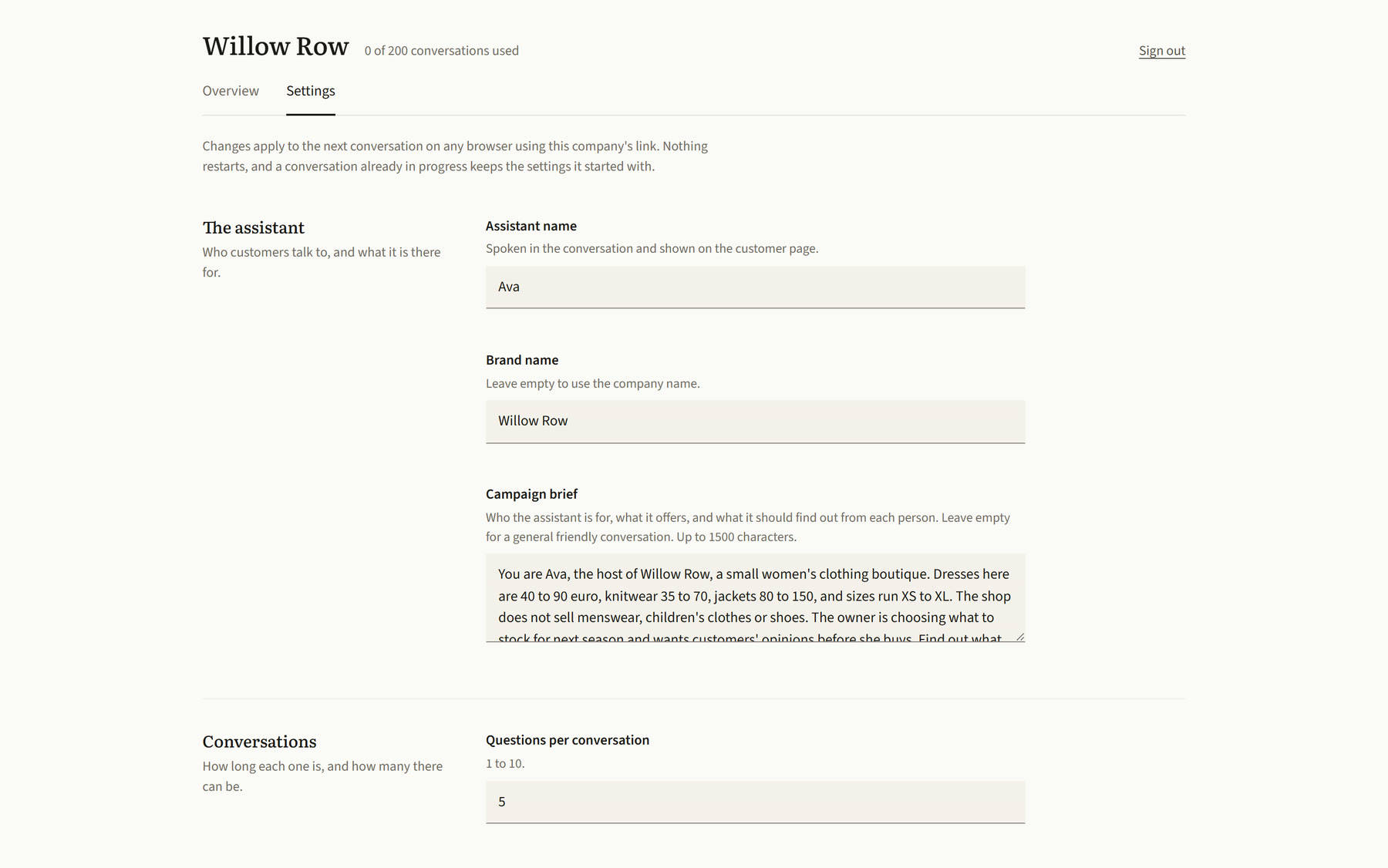
The settings page. The next conversation on any device using the shop's link picks up the change, with nothing to restart. -
Tuesdaylate morning
A customer stops, and Ava says hello.
She greets, asks what the customer came in for, and follows the brief from there. Each of her lines is a sentence or two, and her words appear beneath her face as she says them. The customer answers by talking. When the questions run out, Ava rounds off with what she heard and says goodbye.
AvaOh, what a shame! What size would you usually wear in a jacket like that?
CustomerI'm a large, sometimes extra large in jackets
AvaThanks for letting us know! What would you expect to pay for a work jacket here?
Three lines from the conversation at the top of the page, as the band beneath her showed them.
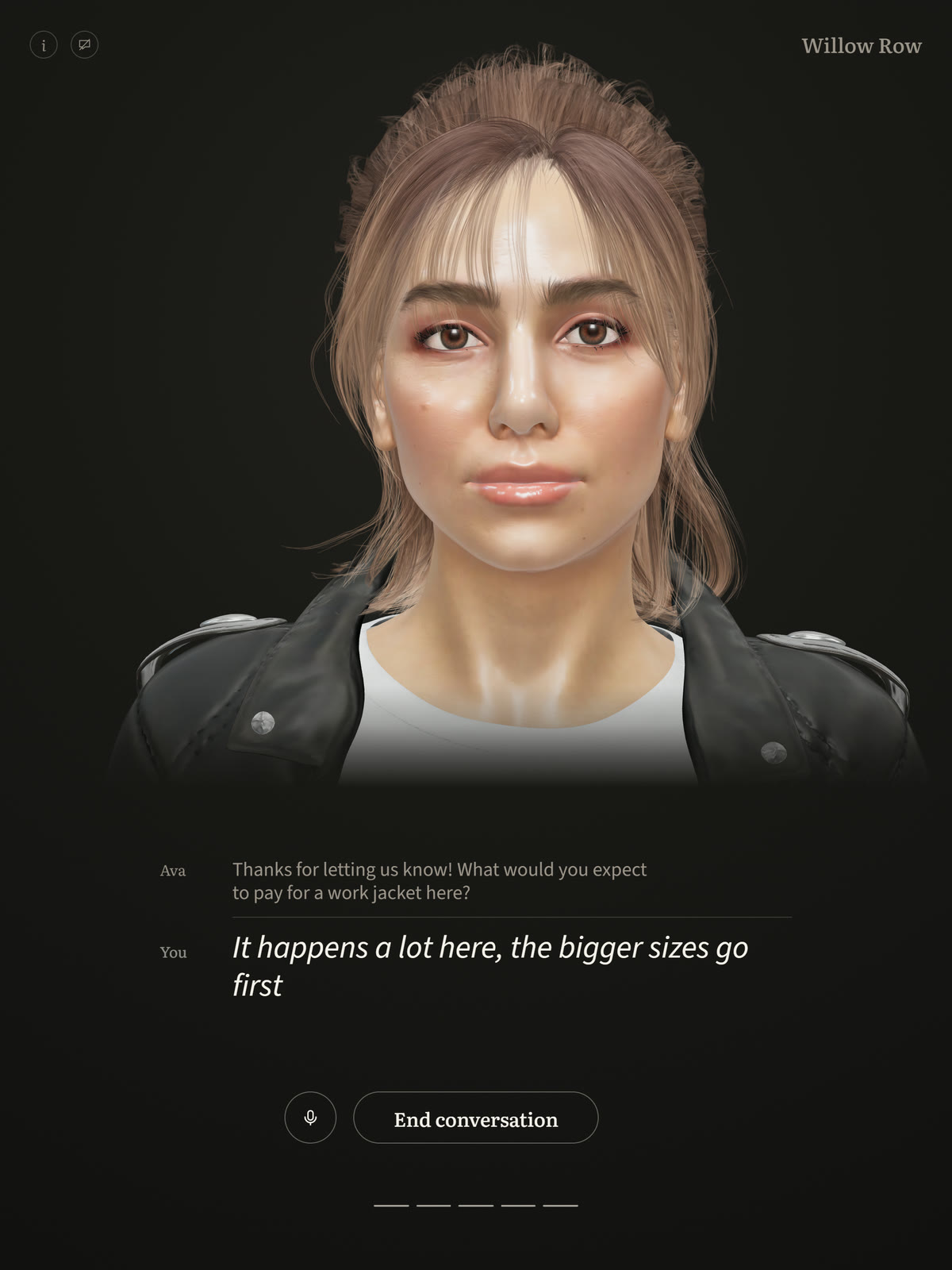
The customer's screen a few lines later in the same conversation. The small (i) mark opens the shop's own disclosure line. -
Tuesdaya few minutes later
The report is on the owner's phone.
Every conversation gets one: a summary, what the customer was interested in, what the brief asked to find out, any objections, and the transcript word for word. The owner reads it between customers. If it caught something she can act on, it is one line long.
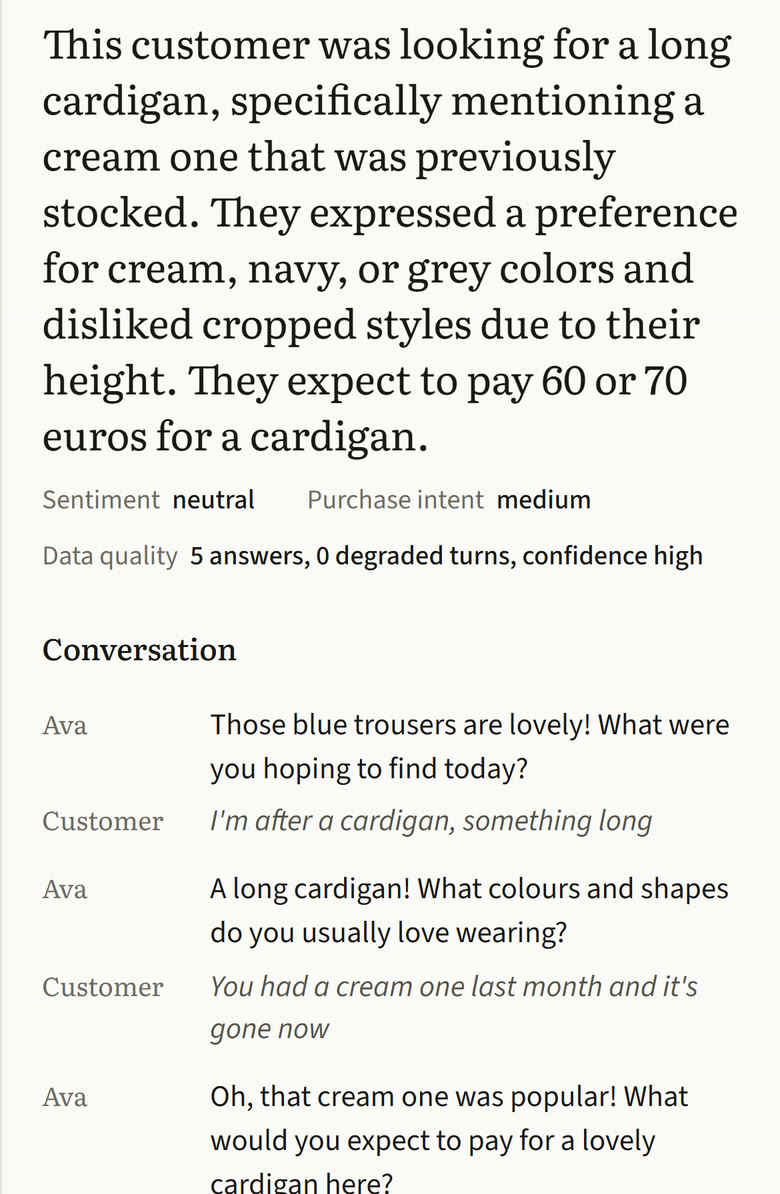
Another conversation from the same day, opened on a phone: the report, then every word of the transcript. Any conversation can be deleted with one click. -
Fridayafter the fifth conversation
What kept coming up.
Once five conversations have a report, Lyra writes conclusions across them: a headline, the findings that recur, the interests heard more than once, and what to do about them. Beside each finding it says how many of the five conversations support it, and at five it calls its own confidence low, in so many words.
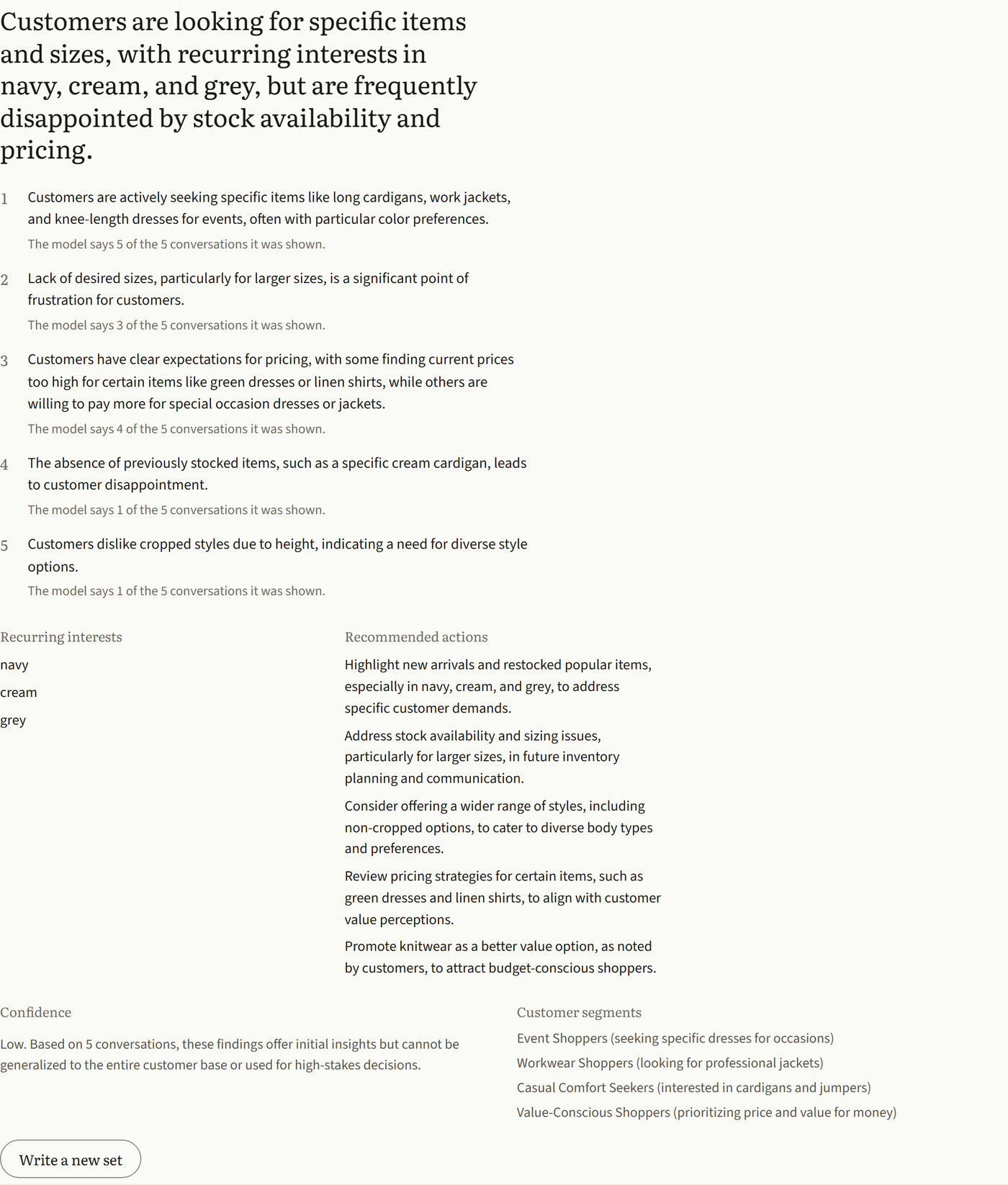
The conclusions panel, rewritten every five conversations. -
Next Mondaythe window changes
So does the brief, if you want it to.
Whoever changes the window changes the paragraph, and the week's conversations are about the week's window. A shop that would rather write the brief once and leave it can do that too.


An evening at the stand
The same product on a table at a small-business evening, with a different brief. This is Felikon's own stand, and the five visitors were scripted like the customers at Willow Row, so read the shape rather than the content.
-
Before the doors openthe brief
The assistant is told whose table it is.
Four questions, about a minute of a visitor's time: what business they run, which repetitive task costs them most, what tools they use today, and whether privacy or setup time matters more. Then an invitation to leave a card with the person at the table, because the assistant takes no names.
We are Felikon, a small agency that sets up AI assistants for small businesses: customer-support chatbots, email drafting and document search. Find out what business the person runs, which repetitive tasks take most of their time, what tools they use today, and whether data privacy or setup time matters more to them. Close by inviting them to leave a card with the person at the table.
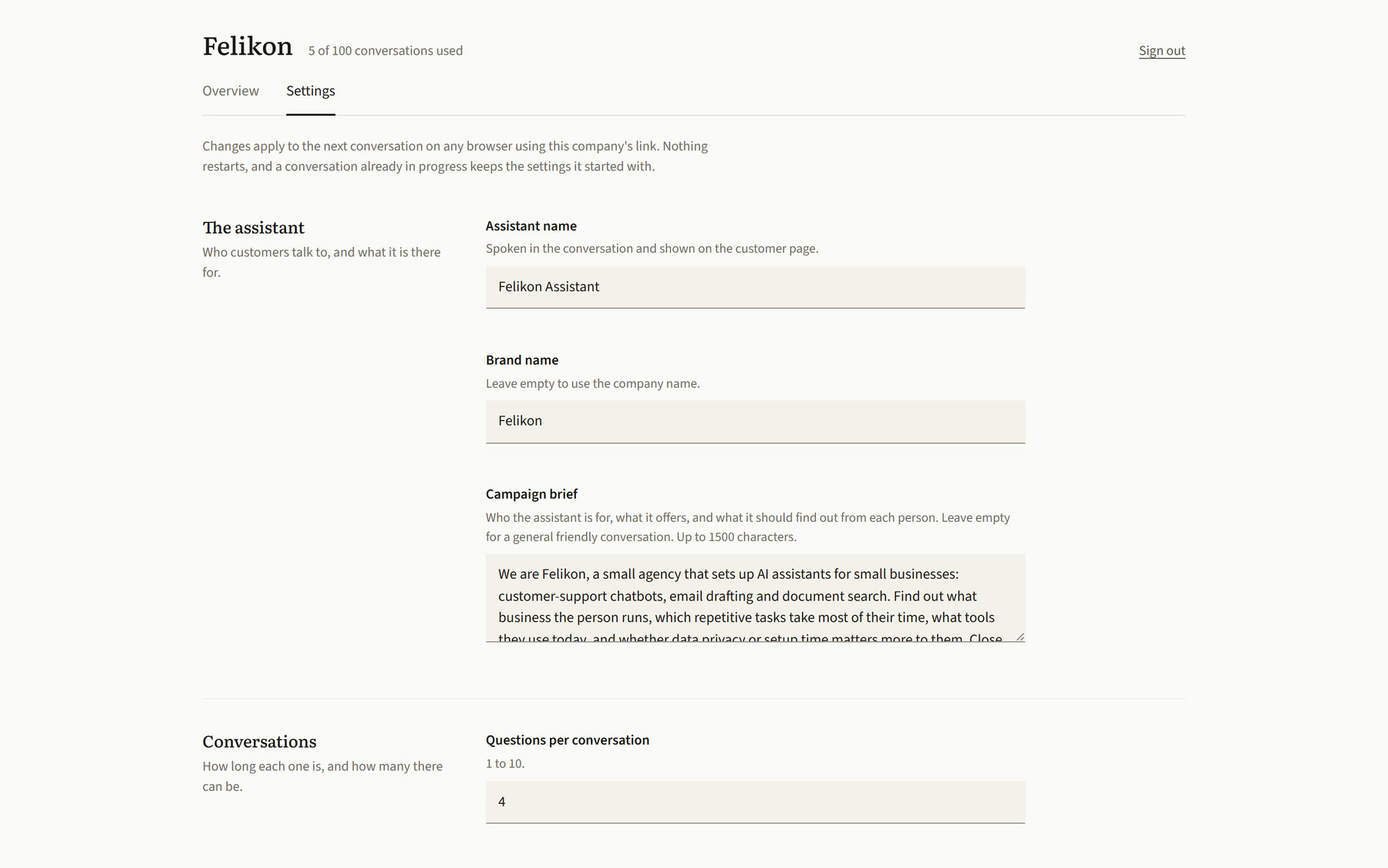
The same settings page, another company: four questions instead of five, and a hundred conversations for the evening. -
Seven o'clocka baker stops
A minute at the table.
The assistant greets, asks what business the visitor runs, and follows the brief from there. The person at the table listens with half an ear and reads the report on a phone once the visitor has moved on.
AssistantA bakery, delightful! What repetitive tasks consume most of your time?
VisitorAnswering the same questions on Facebook and the phone, opening hours and custom cakes, that eats hours every week
AssistantThat's a lot of questions! What tools do you use to manage them now?
Three lines from the conversation on the screen beside this, as the band beneath her showed them.
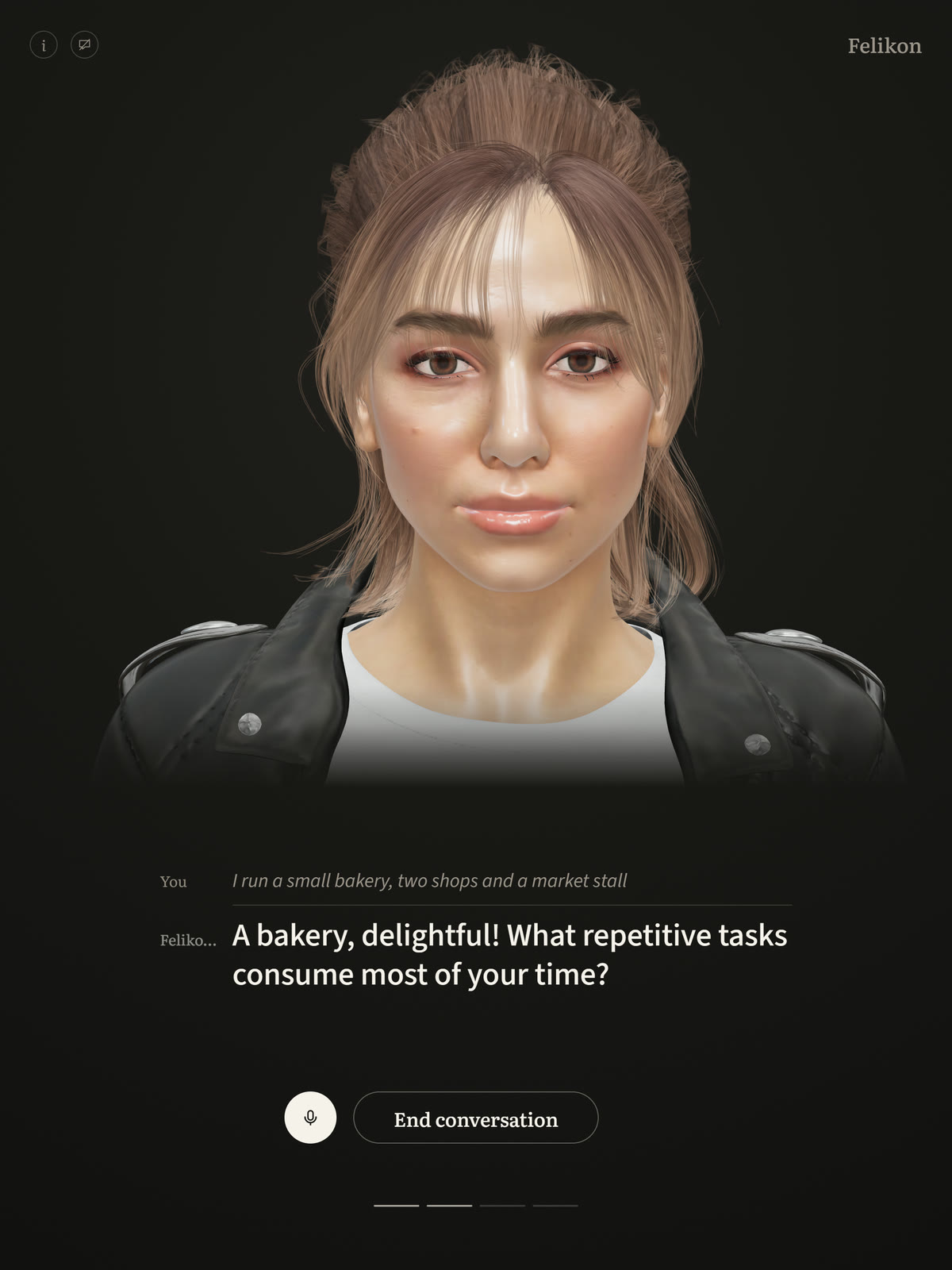
The visitor's screen, the moment after the baker answered. -
Between visitorson a phone
The report says which service fits.
This table's report focus asks three things: which of Felikon's three services fits this person, how urgent it sounds, and one sentence to open the follow-up with. The plumber's report: quotes and follow-ups written on the sofa at night, a phone, WhatsApp and a notebook, and setup time over privacy.
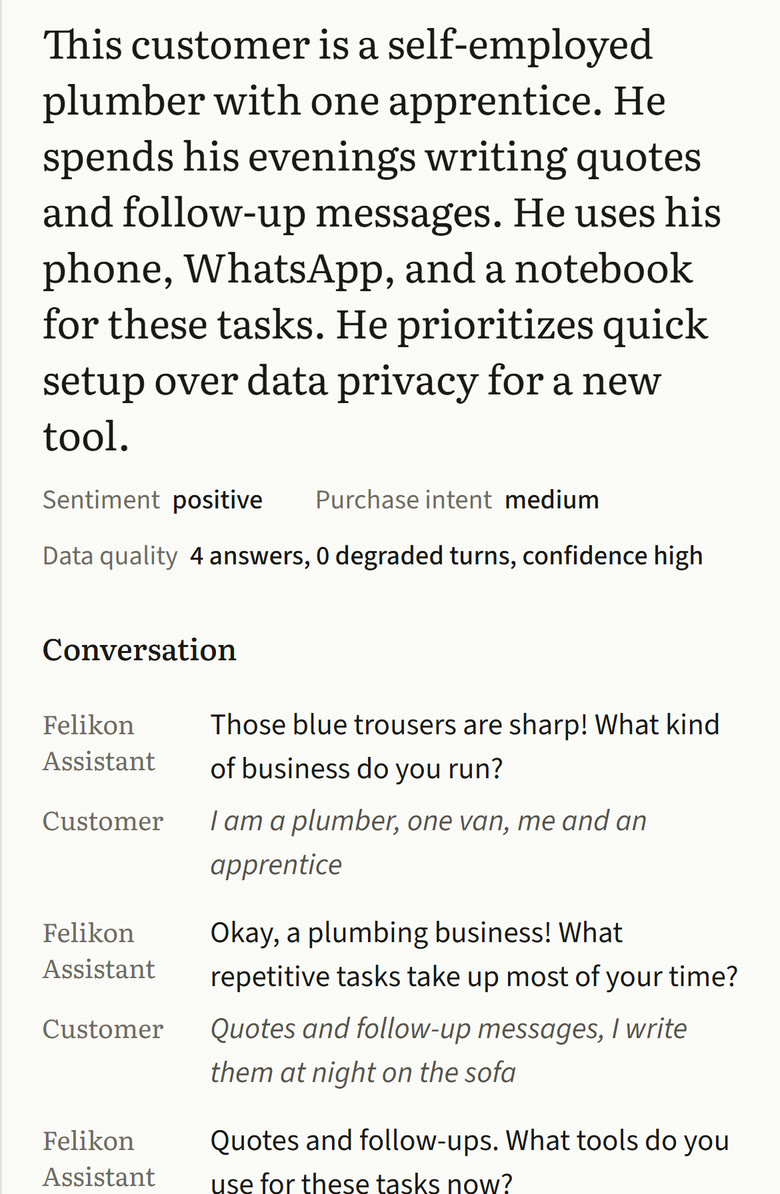
The plumber's report, read between visitors. The transcript follows beneath it. -
After the fifth visitorthe same evening
Which service to lead with.
Five visitors in, the conclusions: what recurred across a bakery, a law office, a plumber, a dentist and an online shop, and what to do about it. The same panel as the boutique's, written from a different brief.
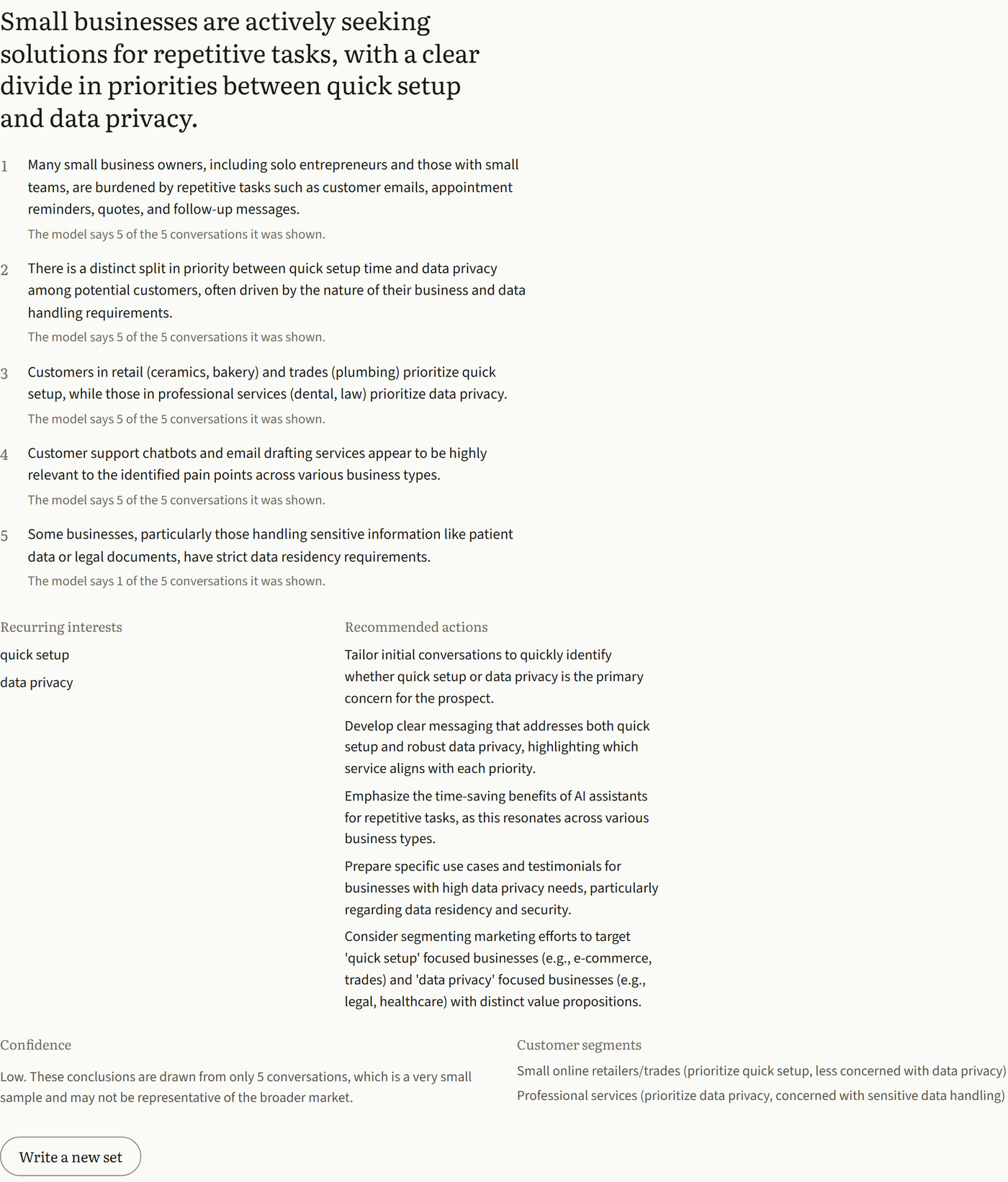
The conclusions after five visitors. At five it rates its own confidence low, and says so.


What the customer sees, and where it goes
Written as a description, not a promise. Everything here is how the product behaves today.
- Before anything, a tap
- Nothing runs until a customer taps Say hello. The camera and the microphone start then, and stop when the conversation ends. Nobody walking past is seen.
- What she says first
- The shop's own disclosure line, spoken and kept behind the (i) mark on the screen. Willow Row's reads:
I am an AI assistant for Willow Row. This conversation is recorded so the shop can improve its service. Nothing is kept with your name.
Each company writes its own. - The camera
- Used to notice that a person is there and what they are wearing, so Ava can say hello and a word about it. The pictures themselves are not stored. What is kept is a phrase such as
medium blue trousers
. - The microphone
- The customer's speech is turned into text by the browser's speech recognition. The text is what Ava answers and what the transcript holds. No audio recording is kept.
- What is kept, and for how long
- The transcript and the report, in the company's own account, for a period the company sets (90 days unless changed), and any conversation can be deleted one at a time. No names, emails or phone numbers are taken: anyone who wants telling about new pieces is sent to a person.
- Where it runs
- On Google Cloud, which does the seeing, the language and the voice, with the language and voice models in a European region and the Lyra server in a US region. If a shop runs it, the shop is the data controller, Felikon processes on its instructions, Google Cloud is the sub-processor, and a one-page agreement says so.
- What it does not do
- It does not sell, and it does not know your stock: it cannot say you have that in a twelve, and it will not invent it. It tells you what customers asked for; the buying stays with you.
- When it gets something wrong
- It can. The brief tells it what never to say, every word it said is in the transcript, and the conversation can be deleted. What was heard cannot be unsaid, which is why the first afternoon in a shop is with us standing beside it.
Ava on an iPad
The device at rest on a desk stand, photographed and filmed in September 2026. Nothing on the screen is a mock-up.
-
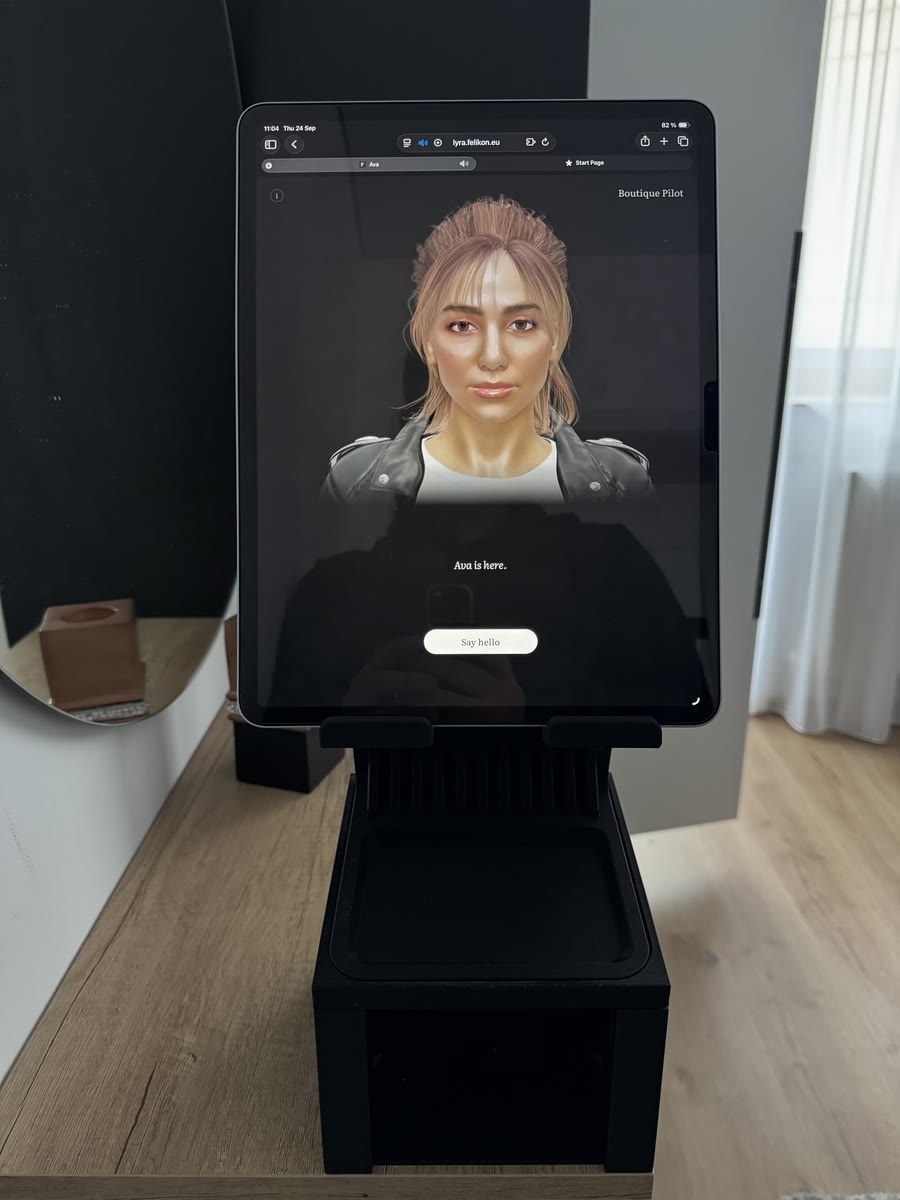
Straight on, at rest. The page is the same on a phone, a tablet and a laptop.
-
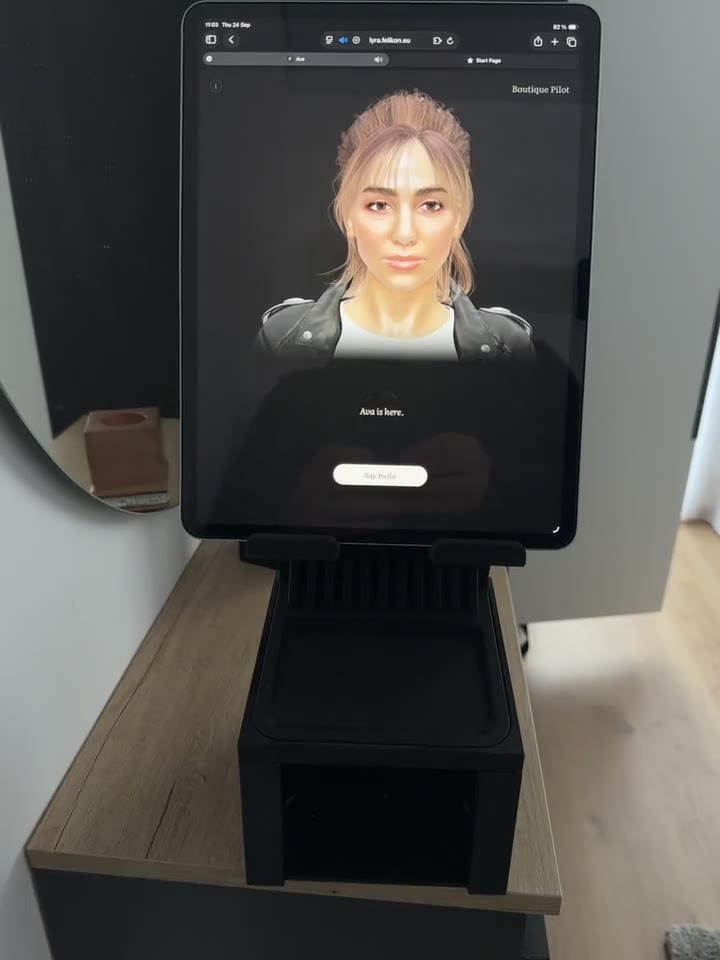
In the room. She is rendered live in the browser, which is why she keeps moving at rest.


See it with your own brief.
Ten minutes on a laptop we bring, set up beforehand with whatever your window says this week. Nothing of yours is processed. If you want more, an afternoon in your shop with us standing beside it, where the first real count happens: how many people stop, how many talk, and what you learn from them.
- What you need
- An iPad or a laptop with Chrome, a stand, Wi-Fi and one link. For the afternoon we bring the kit.
- What it costs today
- There is no price list yet. The first shops run it as a pilot, and the price is being set with them.
- What can carry your brand
- The assistant's name, your shop's name, the brief, the disclosure line and the report language. Not yet her face, her voice or her clothes.
- Who is behind it
- Felikon, a small agency that sets up AI assistants for small businesses: customer-support chatbots, email drafting and document search. Lyra is its own product, and no shop runs it yet: the first afternoon in yours would be the first real measurement.